10 May 2026 | Articles, Articles 2026, Management | By Christophe Lachnitt
Ted Turner, Or The Adventure Of Entrepreneurship
The entrepreneur, who died a few days ago at the age of 87, was rightly celebrated for creating CNN. The rest of his life was every bit as extraordinary.
What first made Ted Turner’s life story so exceptional was its tragedy.
As a child, unlike his sister, he was abandoned by his parents and sent away to boarding school, cut off from his family both geographically and emotionally. There, he developed a deep sense of abandonment. Later, after being taken back in by his parents, he was regularly beaten by his father with belts and wire coat hangers. Then, when he chose to study classical literature in college, his father sent him a letter full of insults to disown him. All his life, Ted Turner longed for his father to affirm his worth and show him some measure of esteem. But his father denied both Ted and himself that happiness by taking his own life in 1963, when Ted was 24.
Ted then took over a debt-ridden family billboard advertising business and expanded it. He later acquired local radio stations, which he sold in order to buy a struggling television station broadcasting in Atlanta. Against all odds, he grew the station, renamed WTCG, in both programming quality and popularity. In 1976, the Federal Communications Commission (FCC) authorized WTCG to use a satellite to distribute its content to local cable operators across the country. By taking on yet more considerable debt, he capitalized on the rise of cable: Many operators picked up WTCG to flesh out their lineups, which increased both its audience and its advertising revenues.

Ted Turner launches CNN – Image created with ChatGPT, Gemini Nano Banana and Midjourney – (CC) Christophe Lachnitt
In 1980, he created CNN. The first 24/7 all-news channel, it revolutionized the media coverage of current events and, in doing so, changed the world. By making global events visible in real time, CNN transformed the way news shapes public opinion and political decision-making. It did not merely create the feeling of watching history unfold live, as during the first Gulf War, when it was the only network on the ground in Baghdad. It also helped alter the course of history itself. One may reasonably doubt, for instance, that the fall of the Berlin Wall and the Tiananmen Square uprising would have had the same global impact without CNN. And yet the channel was anything but an obvious bet. Banks mocked the project, potential partners rejected it, and newspaper owners ridiculed it. Its launch initially seemed to prove them right: It was disastrous technically, journalistically, and financially, to the point that the channel was nicknamed the “Chicken Noodle Network.”
He went on to create many other television channels, including TNT (Turner Network Television), which he launched in 1988 with a promise – “programs that inform, educate, inspire, illuminate, and entertain” – that neatly summed up his philosophy. And, still in the television business, he was probably one of the first people to see Rupert Murdoch clearly for what he was. Murdoch returned the hostility in kind, for example by having the New York Post run the front-page headline “Is Turner Crazy?” Turner’s repeated risk-taking, which brought him to the brink of bankruptcy several times before often leading him to triumph, was not to the Australian’s liking.
He failed in his takeover bid for CBS and nearly lost everything again after acquiring the MGM-UA studio in Hollywood. In 1996, he merged his group with Time Warner. Gerald Levin, who would later demonstrate his remarkable judgment by orchestrating with Steve Case the worst merger of all time (see below), committed an offense just as grave – betraying his supposed friend Ted Turner by stripping him of operational control over the work of his life after that merger.
In January 2000, the newly combined company was taken over by AOL, only a few weeks before the dot-com bubble peaked in March. At the time, it was the largest merger in American history, with a valuation of $342 billion (the equivalent of more than $650 billion today). Incidentally, one should rewatch the press conference announcing the deal to appreciate Steve Case’s arrogance – arrogance all the more staggering when one knows what happened next. The merger failed almost as quickly as its architects had made their sweeping claims: AOL’s share price fell by more than 30% between the announcement of the deal in January and its approval by regulators in December. By early 2002, AOL Time Warner’s market capitalization had fallen to $127 billion, and that year the company posted a net loss of $98.7 billion (roughly $170 billion in today’s dollars), an amount that remains to this day a record for an American company. In addition, in May 2000, AOL had to pay a multimillion-dollar fine after the Securities and Exchange Commission (SEC) accused it of artificially inflating its profits by several hundred million dollars, in what turned out to be the early stage of a multiyear accounting scandal that would mire the new group.
To return to my subject today, Ted Turner’s impact on American culture and global civic life was by no means limited to his television ventures. I will mention only a few examples here, as covering them exhaustively would be difficult.
He devoted himself – unsuccessfully, but with his usual optimism and determination – to the elimination of nuclear weapons.
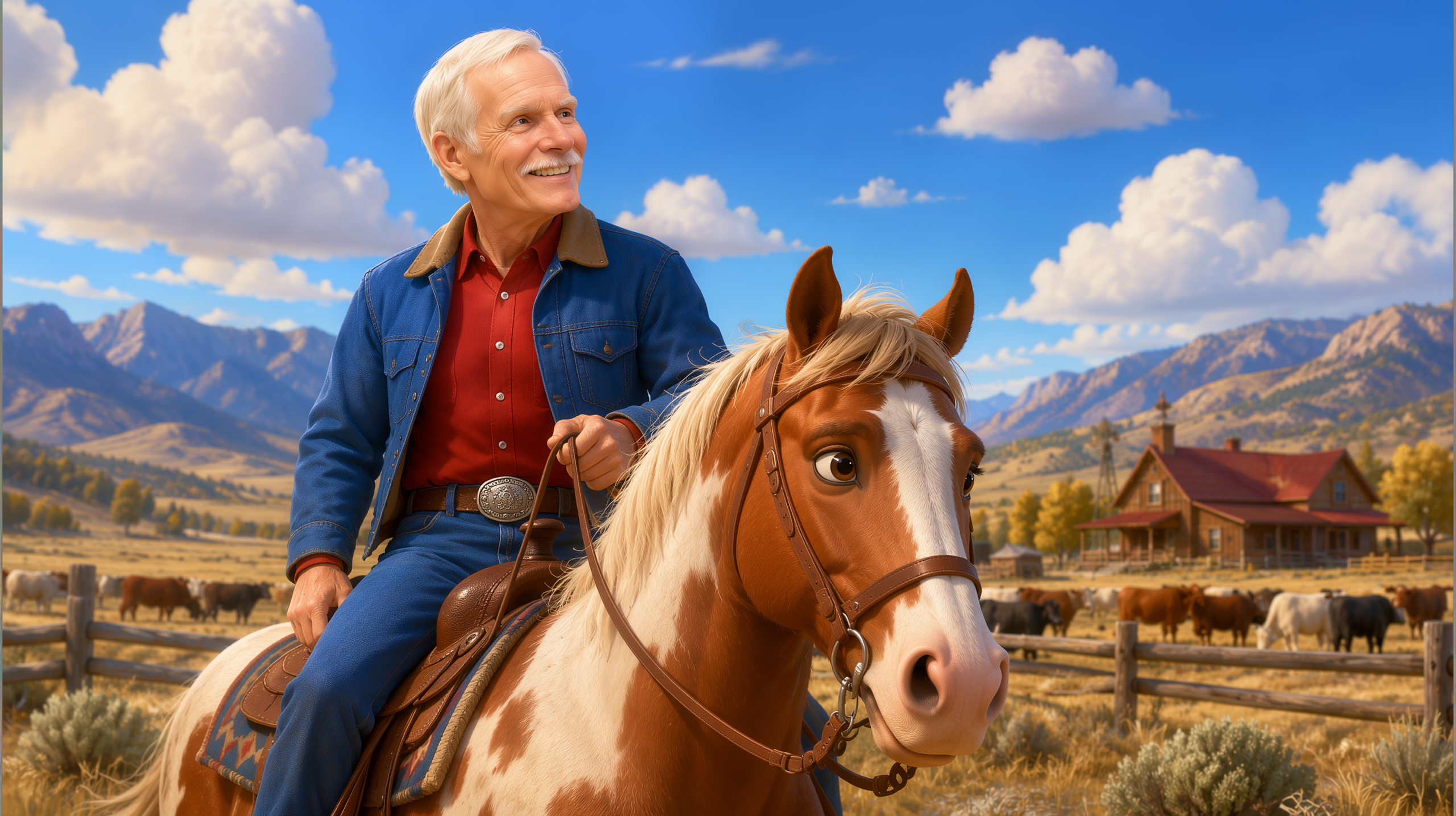
Ted Turner in one of his nature reserves – Image created with ChatGPT and Midjourney – (CC) Christophe Lachnitt
His environmental commitment came early, long before the issue acquired the prominence it has today. He purchased millions of acres of American land, becoming the third-largest private landowner in the country, in order to turn them into nature reserves, and he played a major role in saving numerous animal species, including the bison.
In 1997, he gave $1 billion to United Nations foundations, or one-third of his fortune at the time, reviving the tradition of large-scale philanthropy in the mold of Carnegie and Rockefeller – a practice that would later be embraced by Bill Gates and Warren Buffett. It took him some time to fulfill that pledge, however, because he lost a large portion of his fortune in the AOL Time Warner crash.
He created the Goodwill Games, each edition of which cost him tens of millions of dollars, in response to the reciprocal boycotts of the 1980 Moscow Olympics and the 1984 Los Angeles Olympics. His goal was to foster dialogue through friendly athletic competition between the United States and the Soviet Union during the Cold War. The first Goodwill Games, held in Moscow in 1986, brought together 3,000 athletes from 79 countries and succeeded where the Olympic Games had failed: It enabled American and Soviet athletes to compete together. The Games were then held every four years until Time Warner executives canceled them in 2001.
In sports, Ted Turner was named the world’s top yachtsman four years in a row, and he remains the only sailor to have helmed victories in both the America’s Cup (1977) and the Fastnet Race (1979, in an edition marked by a ferocious storm that caused the deaths of fifteen participants).
If you are interested in Ted Turner’s life beyond this incomplete summary, I recommend watching the six-part documentary series “Call Me Ted” on Prime Video, which CNN devoted to him two years ago. It is fascinating on every level – historical, managerial, media-related, and human – all the more so because it never slips into hagiography. Jane Fonda’s participation, she who called Ted Turner her “favorite ex-husband” after their divorce, is as moving as the tribute she paid to him after his death was announced, one that will bring you to tears.
Jane Fonda wrote in her memoir that Ted Turner’s charisma was like “a 3-D stereophonic, Shakespearean-level, sound-and-light show.” She believed that, given the childhood he had endured, what he became was nothing short of miraculous. For his part, when he became Vice Chairman of Time Warner after the 1996 deal, he explained: “I’m married to Jane Fonda, so I know what it’s like to be No. 2.”
Ted Turner’s temperament was explosive. His humor was all the more legendary because he often directed it at himself, including about his worst failures. But the man nicknamed “The Mouth of the South” was no less generous with verbal attacks against his enemies. He was also known for his outbursts, his abuse of alcohol, and his chronic infidelity. He also made several outrageous remarks that, according to those who knew him, reflected neither the substance of his thinking nor the core of his personality. Ted Turner was therefore not a perfect man1, and this is not an attempt to canonize him.
But he will remain a singular entrepreneur, capable of taking insane risks to bring his strategic visions to life, whatever the field, and an exceptional personality.
I will leave him the last word by quoting his celebrated motto: “Do something. Either lead, follow or get out of the way.”
—
1 He also developed a friendship with Fidel Castro and defended Chinese totalitarianism after the Tiananmen massacre, two episodes that still defy my understanding.
Superception is a media outlet focused on perception issues across communication, management, and marketing in the age of artificial intelligence. It features a blog, a newsletter, and a podcast. It was founded and is published by Christophe Lachnitt.