29 July 2026 | Articles, Articles 2026, Communications, Marketing | By Christophe Lachnitt
Are We Fully Aware That Influencers Are Overtaking Traditional Institutions?
Two recent examples have highlighted a transformation whose full implications may still be difficult to grasp.
The first involves Laura Loomer’s trip to Ukraine. Loomer is one of the most notorious “influencers” in Donald Trump’s MAGA (“Make America Great Again”) ecosystem.
The far-right activist and commentator has repeatedly expressed hatred of Muslims, displayed xenophobic and racist views, and promoted conspiracy theories, going so far as to deny the reality of several mass shootings in the United States and claim that the September 11, 2001 attacks were orchestrated by the U.S. government. As Maggie Haberman and Jonathan Swan recount in detail in their new book “Regime Change” – which, incidentally, I highly recommend – she also led a witch hunt inside the Trump administration, with the President’s backing, aimed at removing officials and staffers she considered enemies of America.
And yet this thoroughly admirable individual has built a large following in the United States, and amassed even greater political influence. So much so that her trip to Ukraine, and her subsequent conversion to the Ukrainian cause, attracted more attention both in Ukraine and in the United States than a visit by virtually any journalist – and by a great many political figures – would have.
For years, Laura Loomer had demonized Ukraine and Volodymyr Zelensky, criticized U.S. support for the country, repeatedly echoed Russian propaganda about the war, and described the Ukrainian president as a “fake Jew.” Then came the kind of dramatic reversal for which converts are famous. Speaking to Zelensky in Kyiv, she admitted that she had been duped. She was anti-Ukraine and consumed a lot of Russian propaganda. She wrote articles for Russia Today, and she now regrets doing that. Eventually, she realized that she had been fooled by Russian propaganda and that it had led her to believe a lot of false things about Ukraine. A courageous admission, if a belated one.
As shrewdly as ever, Volodymyr Zelensky immediately understood how he could make the most of her visit. During their conversation, he raised several issues likely to resonate with the MAGA camp, including strategic competition with China, military innovation – particularly drones – and the benefits the United States could derive from Ukraine’s battlefield experience.
Loomer went even further in her about-face during an interview with the outstanding Russian-born American journalist and author Julia Ioffe. She described herself as having been misled for years by Russian narratives and argued that parts of the Republican Party had been “completely indoctrinated” by Kremlin propaganda. More striking still, she advocated closer U.S.-Ukraine defense cooperation, particularly in drone manufacturing.
Her international transformation has not prevented Laura Loomer from remaining very much herself on the domestic front, however, as demonstrated by tweets indulging in conspiracy theories surrounding the sudden death of Senator Lindsey Graham.
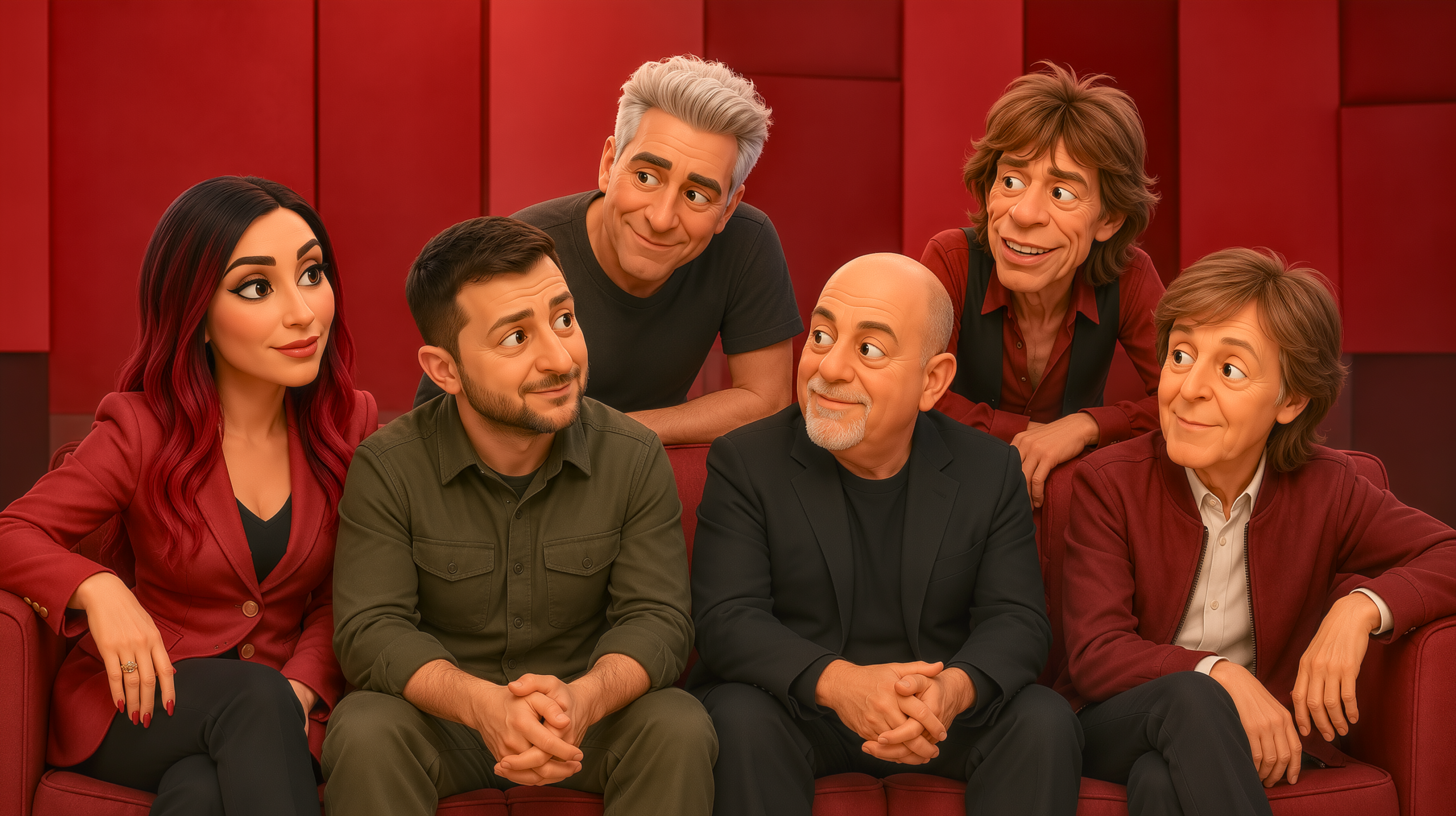
Laura Loomer, Volodymyr Zelensky, Rick Beato, Billy Joel, Mick Jagger et Paul McCartney – Image created with ChatGPT and Midjourney – (CC) Christophe Lachnitt
The other influencer I want to discuss today is Rick Beato, an American musician, producer, and educator whose excellent YouTube channel has nearly six million subscribers, and of which I am a loyal viewer. His videos include song analyses, commentary on the music industry, and interviews with major figures from the music world. Which brings me to the second recommendation in this article: I strongly encourage you to watch or listen to his latest interview with Billy Joel. It is fascinating.
In another recent video, Beato compared his own performance with that of the media outlets favored by some of the world’s biggest stars. While his Billy Joel interview is approaching two million views, Mick Jagger’s interview with The New York Times, released around the same time, has fewer than 900,000. Paul McCartney’s interview with Zane Lowe for Apple Music, posted two weeks earlier, has attracted just 284,000. Even more strikingly, most of the interviews McCartney gave to major media outlets around the release of his latest album, “The Boys of Dungeon Lane“, generated fewer views than Rick Beato’s conversation with Billy Joel.
The question facing every brand, every CEO, and every product manager today is therefore whether they are more like Volodymyr Zelensky, who understands the importance of influencing the influencers, or Mick Jagger and Paul McCartney, who have not yet fully grasped it.
Because every institution, whether it operates in geopolitics, business, society, or culture, is now being challenged, and in some cases rendered obsolete, by the growing influence that individual creators wield over its stakeholders. And the widespread adoption of artificial intelligence will only accelerate this shift. AI will enable the emergence of influential “fake humans,” while simultaneously giving human influencers increasingly powerful tools to reach and persuade their audiences, both through what they say and how they say it.
Yesterday, influencers revolved around institutions. Tomorrow, institutions may revolve around influencers. And in this new power game, those who fail to influence the influencers may soon find that they no longer influence very many people at all.
Superception is a media outlet focused on perception issues across communication, management, and marketing in the age of artificial intelligence. It features a blog, a newsletter, and a podcast. It was founded and is published by Christophe Lachnitt.