16 September 2026 | Articles, Articles 2026, Management | By Christophe Lachnitt
This Summer, I Visited An Amazon Fulfillment Center. What I Saw There Were Two Very Different Futures Of Work.
The paradox is that the same technologies are helping bring both of them about.
Amazon’s fulfillment centers are where products ordered online are stored, picked, packed, and shipped. The facility I visited in the United States ships one million items a day and employs 2,400 people. It handles products smaller than a microwave oven; larger items are processed at another facility nearby.
The communications strategy behind opening these facilities to the public is presumably intended, at least in part, to counter the poor reputation that has long surrounded them, a reputation fueled by numerous employee accounts and several major investigations, including reporting by The New York Times, The Washington | Post, Reveal, The Los Angeles Times, and The Guardian.
To Amazon’s credit, however, the tour I joined did not feel like an exercise in corporate propaganda about working conditions, which would probably have been even more counterproductive than what we actually saw, and it was remarkably transparent. We toured the entire facility while it was operating normally, not some Potemkin village of logistics. Our visit, conducted along the walkways reserved for people while much of the facility itself serves as a playground for robots, was led by three employees from the site. Over the course of our ninety-minute tour, we also encountered many other employees at their regular workstations.
My sense, therefore, was that we were not being subjected to the kind of staged “transparency” that some behind-the-scenes corporate tours offer. The transparency was inevitably organized, but it did not strike me as artificial. Put differently, judging from my experience, these tours are very thoughtfully designed and engagingly conducted. It is probably no coincidence that Amazon ran 16,000 of them in 2025, attracting 135,000 participants.
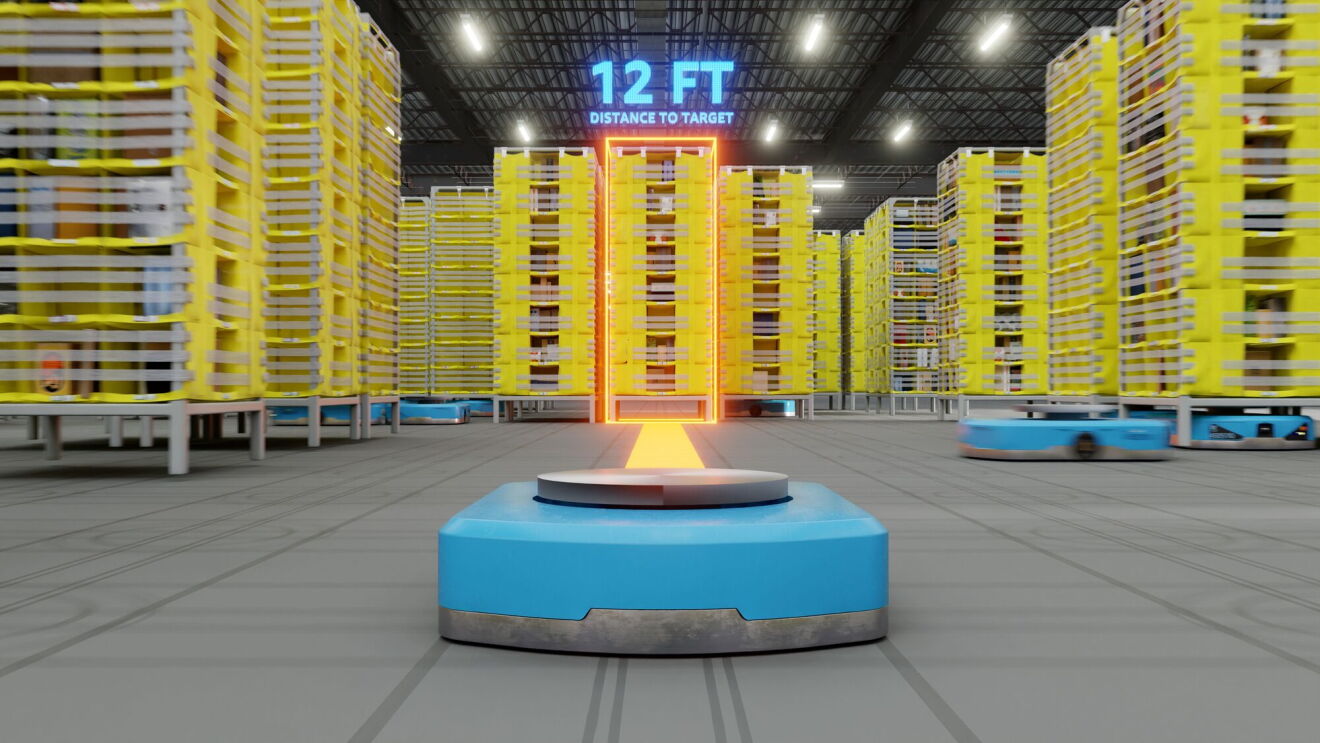
Some of the robots used in Amazon fulfillment centers – (CC) Amazon
I was enormously impressed by the technology Amazon uses in its fulfillment centers: Software, a wide variety of robots, and sophisticated systems for visualization, guidance, tracking, management, and orchestration. The technologies Amazon has developed or acquired, including the robots originally created by Kiva Systems¹, point to one possible future of work, in which innovation not only increases productivity but also makes employees’ jobs easier. Kiva’s mobile robots, for example, transformed order picking by bringing entire storage racks directly to Amazon employees rather than requiring workers to walk through the warehouse to retrieve products.
I was also struck by the sense of solidarity and pride displayed by the people we encountered during the tour, something that, on this scale, would be difficult to dismiss as mere theater. Culturally, the role of managers, symbolized by the words “How can I help?” printed on their vests, appears to be less about supervision than about helping operations run effectively.
That said, supervision itself is largely performed through automated monitoring of employees’ activity. And this raises an interesting question: If a manager’s role is primarily to help team members, how much latitude does that manager actually have to organize the work when so much of it is already structured and paced by Amazon’s technological systems?
But another aspect of the visit stayed with me just as strongly.
I felt as though I were seeing a second future of work, one that, paradoxically, looks very much like a return to the past. In some respects, the Amazon fulfillment center I visited brought to mind Charlie Chaplin’s “Modern Times:” Jobs broken down into microtasks, work standardized, performance continuously measured. The most advanced technologies do not necessarily eliminate Taylorism. They can reinvent it with an unprecedented degree of sophistication. The assembly line from “Modern Times“ has gone digital.
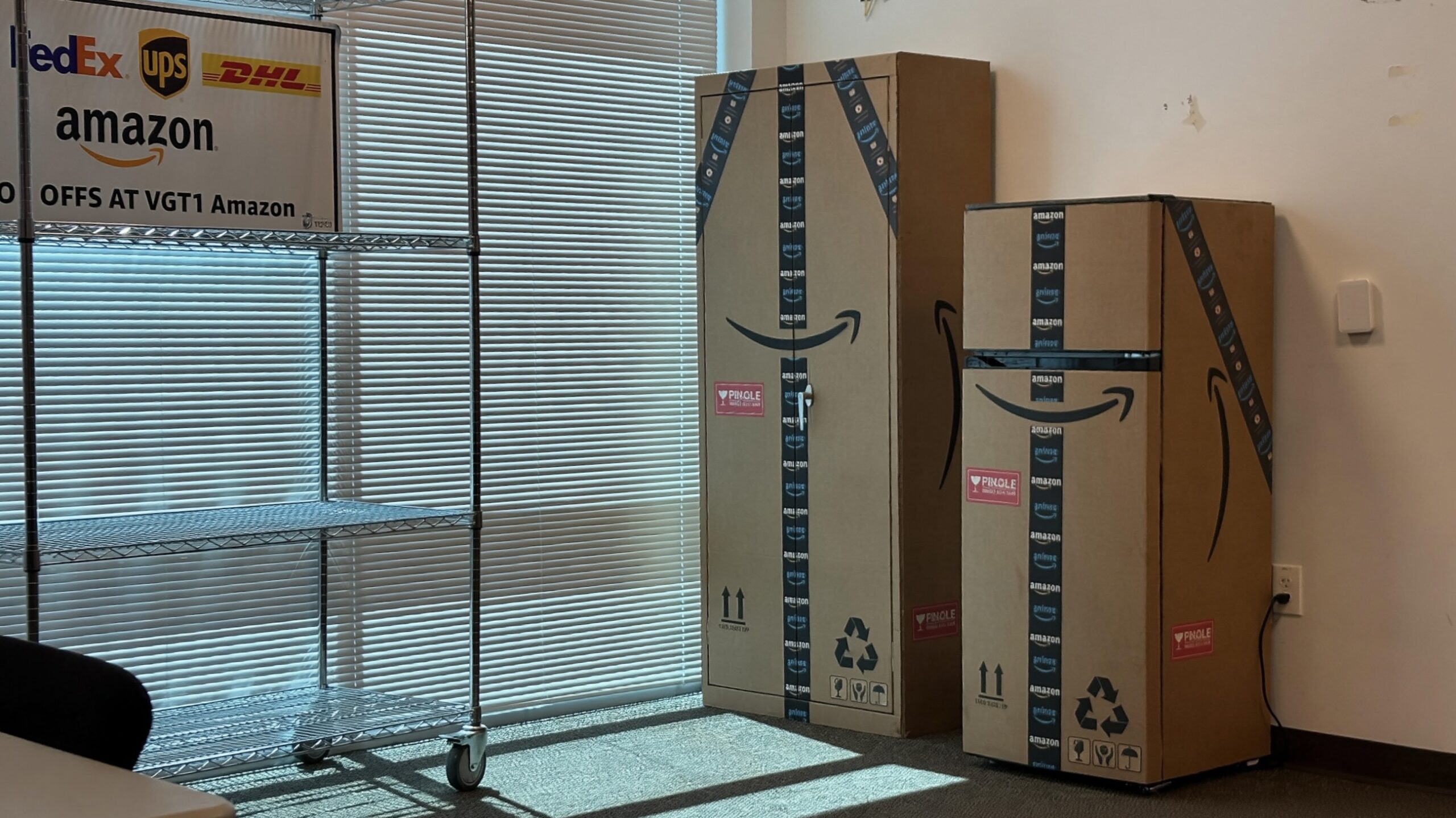
Photography was not allowed during the tour, so the only image I can share with you – just for fun – is this shot of a cabinet and refrigerator decorated to look like Amazon packages in the briefing room – (CC) Christophe Lachnitt
That is the fundamental paradox revealed by the visit. Amazon, which has more than one million robots operating across its logistics network, rightly points out that automation eliminates walking, heavy lifting, and many repetitive physical movements, making work safer and less physically demanding. That is undeniable. But automation can also lead to a mechanization of human work that does not necessarily translate into better working conditions. In fact, automating one part of a value chain can also have the effect of automating the human work that remains within it. Automation concentrates people on the tasks that robots cannot, or cannot yet, perform, while subjecting those tasks to the pace of the automated system. Otherwise, much of the benefit of technological automation would be lost. The result is that the human being ultimately adapts to the technology, rather than the other way around. That was clearly visible during our visit. Employees may no longer have to walk long distances or carry heavy loads, but many of them still perform highly standardized and repetitive tasks.
The ultimate technological solution to this paradox, and perhaps the only way to reconcile the two futures of work I saw inside Amazon, would be to automate the entire value chain. Advances in humanoid robotics may eventually make that possible. But that would amount to solving the problem of repetitive work by eliminating the worker.
Until then, the question is not simply which tasks machines can take away from people. It is also what kind of work they leave behind for them.
—
¹ Kiva Systems, now Amazon Robotics, was acquired by Amazon in 2012.
Superception is a media outlet focused on perception issues across communication, management, and marketing in the age of artificial intelligence. It features a blog, a newsletter, and a podcast. It was founded and is published by Christophe Lachnitt.