1 October 2026 | Articles, Articles 2026, Communications, Management | By Christophe Lachnitt
Is The Author Part Of The Work?
Six questions raised by the literary controversy surrounding Thélyson Orélien’s “C’était ça ou mourir.”
A brief explanation for readers outside France: In the fall of 2026, “C’était ça ou mourir” (It Was That Or Die), by Haitian-Canadian writer Thélyson Orélien, became one of the sensations of France’s rentrée littéraire – the highly competitive fall publishing season during which hundreds of new novels are released and the country’s major literary prizes are awarded.
Then the story changed. An anonymous account on X accused Orélien of having written much of the novel using generative AI, based in particular on results from Pangram, an AI-text detection system. Pangram subsequently analyzed the entire book and reported a 95% probability that generative AI had been involved, with some passages receiving even higher scores. Pangram’s co-founder has said he has no doubt that AI was used. Orélien has categorically denied the allegation. At around the same time, separate allegations emerged that texts Thélyson Orélien had published more than a decade earlier contained passages copied or closely adapted from other sources.
The revelations concerning Orélien’s earlier alleged plagiarism naturally make the conclusion reached by Pangram – an excellent AI-detection tool, in my view – that the book may have been written with or by generative artificial intelligence seem more plausible.
Several prominent figures have said that, if this were indeed the case, the book would immediately lose all interest in their eyes. That position implies that the author is part of the work itself: If the author disappears, partially or entirely, the supposed creation loses its value.
And yet, before the controversy, “C’était ça ou mourir” had been:
- Awarded the Prix du Roman Fnac.
- Considered for several major literary prizes.
- Widely praised by critics.
- Purchased by tens of thousands of readers.
- Sold for translation into more than twenty languages.
The text has not changed. What has changed is what we believe about the process that produced it: Apparently less human and more algorithmic than expected. That this revelation should damage Thélyson Orélien’s reputation is entirely understandable. Readers and critics feel deceived. Instead of being a celebrated writer, he becomes, in their eyes, the perpetrator of a deception.
But the first question raised by the novel’s possibly artificial origins is this: Why should the novel itself be condemned? Is it because its critics are embarrassed to have enjoyed fiction written by an algorithm? Or should we always judge an author’s intentions as well as the work itself?
Following that reasoning leads to a second question: Does every work necessarily contain an autobiographical dimension, not necessarily in the mind of its creator, but at least in the mind of the person experiencing it? If so, whom should we rather read: Céline or a generative AI? For readers unfamiliar with French literary history, Louis-Ferdinand Céline is regarded as one of the major French writers of the twentieth century and, at the same time, was the author of virulently antisemitic pamphlets. If we choose to judge literature partly on the basis of intentions and values, human inauthenticity strikes me as infinitely less disqualifying than antisemitism.
Some people argue that we should separate the art from the artist when the artist repulses us. Why, then, should it be impossible – sometimes for those very same people – to separate the work from its creator when that creator happens to be a machine? Why could we not appreciate creations produced by artificial intelligence while condemning the people who lie about how those creations were made?
Consider another famous episode in French literary history. Romain Gary published several novels under the pseudonym Emile Ajar, concealing his identity so successfully that “La vie devant soi” won the Prix Goncourt in 1975. Romain Gary had already won the same prize under his own name in 1956, even though, in principle, an author may receive the Goncourt only once. Was the writing attributed to Emile Ajar somehow less good once the world discovered that Emile Ajar was actually Romain Gary? And what if Romain Gary, instead of hiding behind a pseudonym, had used generative technology? Does rejecting a work because no human created it amount to saying that a work of art must always be the manifestation of a consciousness? Is imagination- the very substance of fiction – not sufficient in itself, regardless of where it comes from?
The number of literary critics fooled, in very different ways, by Romain Gary and Thélyson Orélien illustrates something interesting: Our interpretation of creative subjectivity works much better after the fact. In a blind test, the human mind can be swept away by the emotions produced by a book regardless of whether the words were written by a person or generated by a technology. The new reality brought dramatically into focus by “C’était ça ou mourir” is therefore that an algorithmic creation can be as good as a human one. We have already seen this in other creative fields. One example is the remarkable synthetic song “Walk My Walk” by Breaking Rust, which reached the top of the U.S. country charts.
This controversy therefore raises a third question: What criteria determine how we evaluate a work? Will quality itself no longer be enough? Will it increasingly be supplemented, or even superseded, by a criterion of provenance? I do not believe that will ultimately be the case, although we will almost certainly go through a transitional period. And here lies another paradox. If an artist discloses having worked with generative AI, that disclosure may make it almost impossible for some audiences to appreciate the resulting work on its own merits. But if the artist conceals it, he or she can legitimately be regarded as a fraud.
It is worth remembering that photography, too, had a difficult beginning. Some painters initially saw it as a threat. Yet photography ultimately helped liberate painting from the obligation to reproduce reality faithfully, and, in doing so, opened entirely new territories for artistic expression.
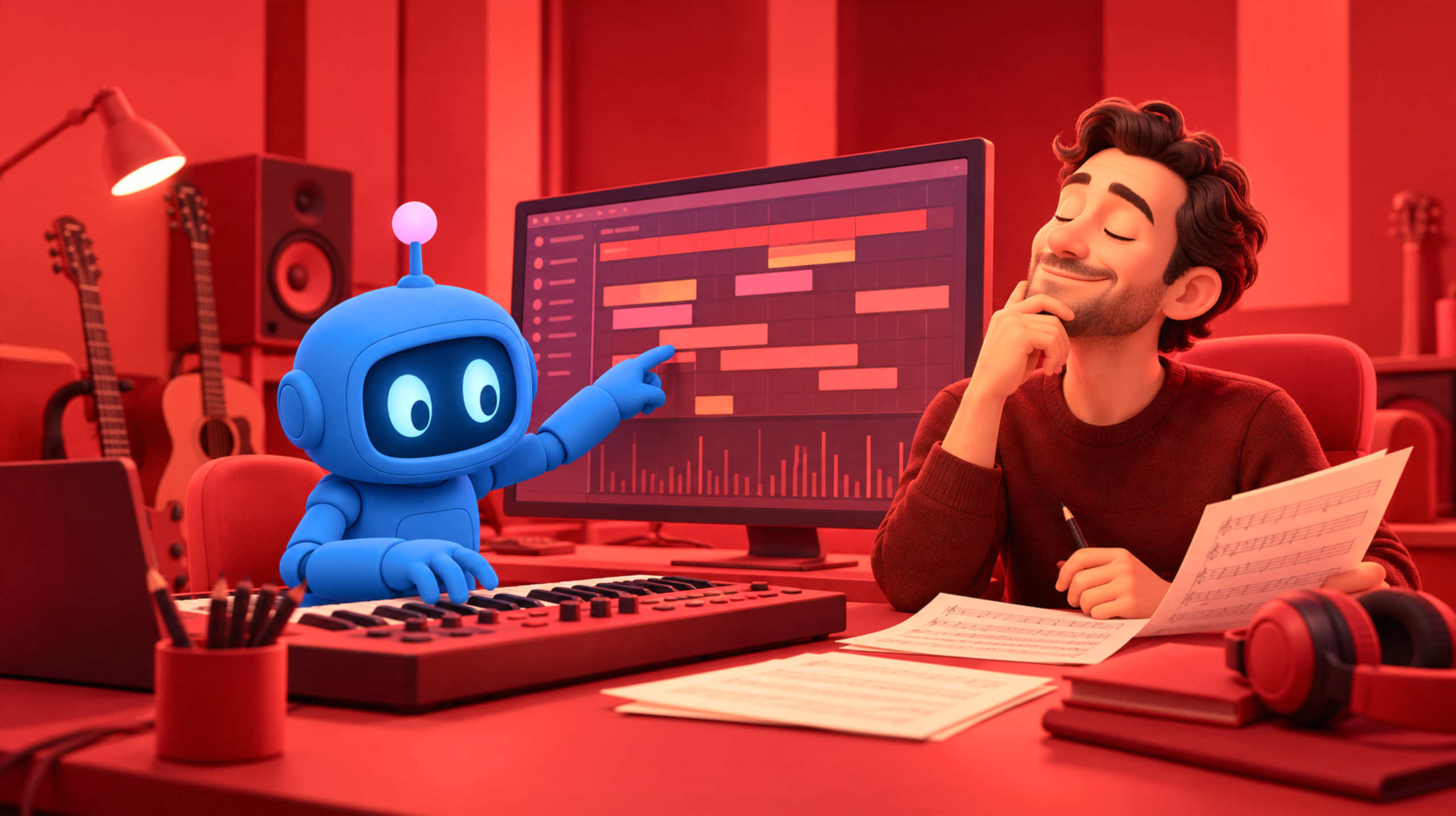
Image created with ChatGPT and Midjourney – (CC) Christophe Lachnitt
The scandal raises a fourth question: Must a work be the product of a creator who has somehow earned our admiration in order for us to find the work compelling? If we accept that principle as an argument against generative AI, should we also prefer the work of artists who labor painfully over their creations to the work of effortless geniuses? Should we dislike “Yesterday” because Paul McCartney woke up one morning after having dreamed its melody?
A fifth question concerns human responsibility. This issue is already central to the safety challenges posed by AI agents. Such systems may have a degree of autonomy, but they were initially created by humans and, when things go wrong, it is often because those same humans inadequately designed or secured the environments in which they operate. In creative fields, the use of artificial intelligence will become increasingly difficult to detect. One might therefore assume that the more AI becomes capable of creating like a human being, the less relevant the issue of authenticity will become. I suspect the opposite will happen, at least during the transitional period I mentioned earlier.
The creative process itself will become increasingly important. Trust in human creation will depend on the creator’s transparency. Some people may even demand proof of a work’s provenance, an unbroken record of how it came into existence. That is largely an illusion. The less detection becomes possible, the more trust will have to rest on disclosure.
Which brings me to a sixth and final question, one that is less about rules and more about emotion: Will we still be capable of admiring an artist once we begin to suspect that the artist’s genius may actually be artificial? Peter Jackson’s Beatles documentary “Get Back” is extraordinary in part because it places us inside the Fab Four’s creative process. We watch Paul McCartney, for example, pull “Get Back” and several other masterpieces out of thin air. Tomorrow, we may find ourselves wondering whether a musician appearing to compose something spontaneously in front of a camera is really creating it, or merely reenacting a piece an algorithm generated before the camera started rolling.
Of all the dangers associated with generative artificial intelligence, this possible loss of our capacity for admiration is one to which I am particularly sensitive. Once every work can be suspected of having been augmented or produced by a machine, it will not be only the value of the creation itself that comes into question. It will be the value of talent itself.
I fear an age of permanent suspicion – one that could deprive us of so many positive emotions.
Superception is a media outlet focused on perception issues across communication, management, and marketing in the age of artificial intelligence. It features a blog, a newsletter, and a podcast. It was founded and is published by Christophe Lachnitt.