15 April 2026 | Articles, Articles 2026, Management | By Christophe Lachnitt
The Greatest Champions Aren’t Who You Think
Some dominate their opponents. Others must first learn to master themselves.
The world of sports – players, commentators, and fans alike – has been conditioned to admire “killers:” The likes of Michael Jordan, Kobe Bryant, and Tom Brady, who feed off pressure to elevate their performance even further. We admire them because we see them as superhuman, capable of feats that seem all the more extraordinary precisely because they are so far removed from what we can do.
Rory McIlroy: The Most Human Of Sporting Legends
But when you think about it, isn’t the achievement of an athlete who is closer to us – more human, more vulnerable to pressure – even more remarkable? That’s the question raised by the outstanding documentary produced by Amazon Prime about Rory McIlroy’s victory at the Masters last year, which made him only the sixth player in history – and the first European – to complete the career Grand Slam. It was a goal he had pursued for no less than eleven years, hinging on a single condition: Winning the Masters. And yet, during those eleven seasons, not only did he fail to win at Augusta, he also didn’t capture any other major, despite being seen in the early 2010s as a potential successor to Jack Nicklaus and Tiger Woods. Naturally, this double drought – at the Masters and across the other majors – intensified the pressure he faced each time he stepped onto the biggest stages.
What makes this film so compelling is McIlroy’s candor about his flaws and vulnerabilities. A player universally recognized for his pure brilliance began to experience impostor syndrome in his pursuit of the Grand Slam. He didn’t feel he measured up to the five players who had achieved it, especially his idol, Tiger Woods. Can you imagine Michael Jordan struggling with impostor syndrome? Equally telling, there were years when McIlroy didn’t fully commit at Augusta, afraid of the disappointment he might feel if he failed again. In the end, one of the greatest challenges he faced at the Masters was mastering his own demons – especially his 2011 collapse – and “all the little ghosts” left behind by the failures of other great players.
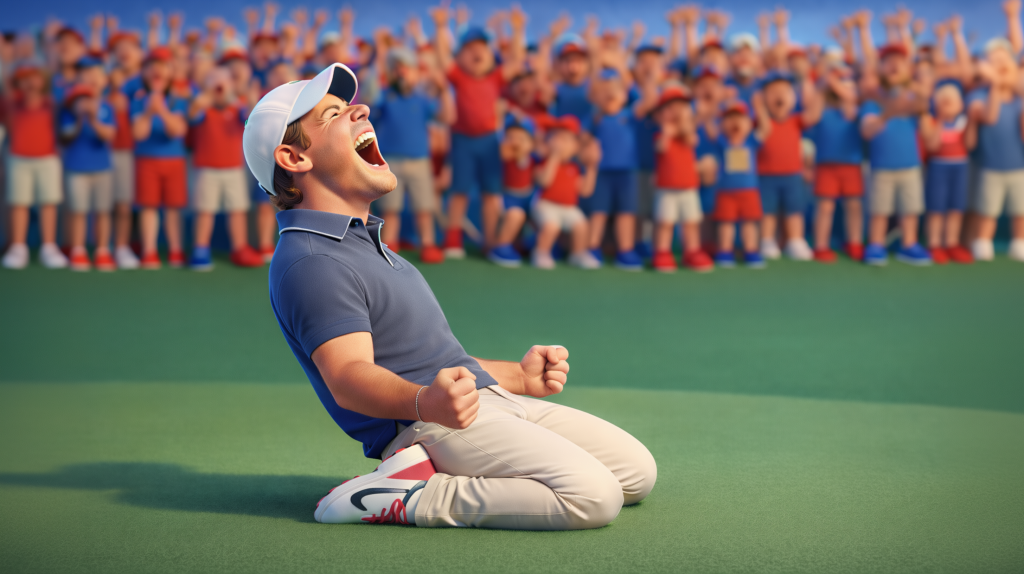
These vulnerabilities nearly cost him the title last year. On the final day, he endured a kind of mental torture rarely seen in a champion, mixing shocking mistakes with flashes of genius (like his recovery on the seventh hole). Dr. Bob Rotella, one of the world’s leading sports psychologists, puts it simply: “Failure doesn’t destroy you. Doubt and fear do.“
Pressure: Performance’s Demanding Companion
Choking under pressure is a well-documented human phenomenon. Research shows that pressure increases conscious attention to one’s own actions, disrupting the automatic execution of movements that are usually mastered. Experts in any field rely on procedural memory to perform actions automatically, without conscious thought. Under pressure, they begin to overthink those actions, losing the instinctive flow that makes them effective. The result: Desynchronized movements, reduced fluidity, and small errors that trigger a negative mental spiral that is extremely difficult to escape.
In reality, performance doesn’t depend on stress itself, but on how it is interpreted: As a challenge or as a threat. When the brain sees pressure as an opportunity, it mobilizes physiological resources, especially blood flow, to rise to the occasion, enhancing performance. When it perceives it as a threat, it generates anxiety and physical rigidity, which undermine performance.
This is what makes McIlroy’s ability all the more remarkable. After a psychological nightmare of a final round last year, he managed to regain his composure at the start of a playoff against Justin Rose and win in sudden death. To do so, he had to overcome not only the pressure built up over a decade, but also the failures of the previous four hours. Michael Jordan would have fed off those moments; McIlroy had to keep them from consuming him. His performance may have been less spectacular, but it was no less admirable. In fact, he later said he felt more relief than joy after the victory.
His second consecutive Masters win last Sunday was less painful, though not without drama. “Rors” squandered a record six-shot lead and fell to fourth place before once again mastering himself to defeat his opponents.
Tiger Woods: The Two Faces Of Pressure
Finally, it’s impossible not to mention Tiger Woods, who represents a uniquely revealing case of a superhuman champion becoming human. For years, “the Tiger” piled up victories, dominating his opponents both technically and, perhaps even more importantly, mentally. Many had already lost before even facing him. Then came his fall: A sex addiction scandal, followed by multiple physical setbacks, including several back surgeries. His 2019 Masters victory, twelve years after his last major, was no longer that of an all-powerful ruler of the sport, but of a far more ordinary player, one who had learned to live with his limits. The tyrant had become a survivor.
We admire “killer” champions for their dominance. But perhaps we should admire vulnerable champions even more. Because their ability to outperform others begins with their ability to overcome themselves. Their victory isn’t just athletic – it’s personal.
And that changes what we value in them… and in ourselves. These deeply human champions offer lessons that are far more accessible to the rest of us. That, in itself, is no small achievement.
Superception is a media outlet focused on perception issues across communication, management, and marketing in the age of artificial intelligence. It features a blog, a newsletter, and a podcast. It was founded and is published by Christophe Lachnitt.