16 May 2025 | Articles, Articles 2025, Communications | By Christophe Lachnitt
In The Age Of Generative AI, Every Communicator Must Channel Paul McCartney
The creative and productive capabilities of generative artificial intelligence are virtually limitless. But for communications professionals, this power comes with its share of risks.
First, because of its efficiency, this technology tends to push communicators toward operational tasks at the expense of strategic thinking. Second, while AI can generate any type of content, it doesn’t know which content should be created. With it, we can do anything – and everything – but the challenge lies precisely in not doing just anything. We must avoid straying from the brand’s territory – primarily its meaning, and secondarily its visual identity – which supports the image and reputation of the organization we represent. We must resist abandoning our communications strategy simply because any idea now seems executable.
In this context, the role of a brand’s editor-in-chief – embodied by the chief communications officer – must rely more than ever on selectivity and prioritization when it comes to content and activation choices. You can’t expect your target audience to reconstruct, after the fact, the coherence you failed to build into your messaging from the outset.
To illustrate this reality, let’s turn to the Beatles.
Generative artificial intelligence can now produce songs in the style of the Fab Four – I actually play one for the communications professionals I train on the strategic implications and operational uses of this technology, created with ChatGPT o1-preview and Udio. But what artificial intelligence can’t do is create an artistic movement that sparks a cultural revolution – the kind Paul McCartney launched with Sgt. Pepper’s Lonely Hearts Club Band. Artificial intelligence lacks both the grasp of social unrest and the ability to reflect – or even shape – it in a truly innovative work. In other words, it lacks two qualities essential to our humanity and to our relevance as communicators: Intuition and taste.
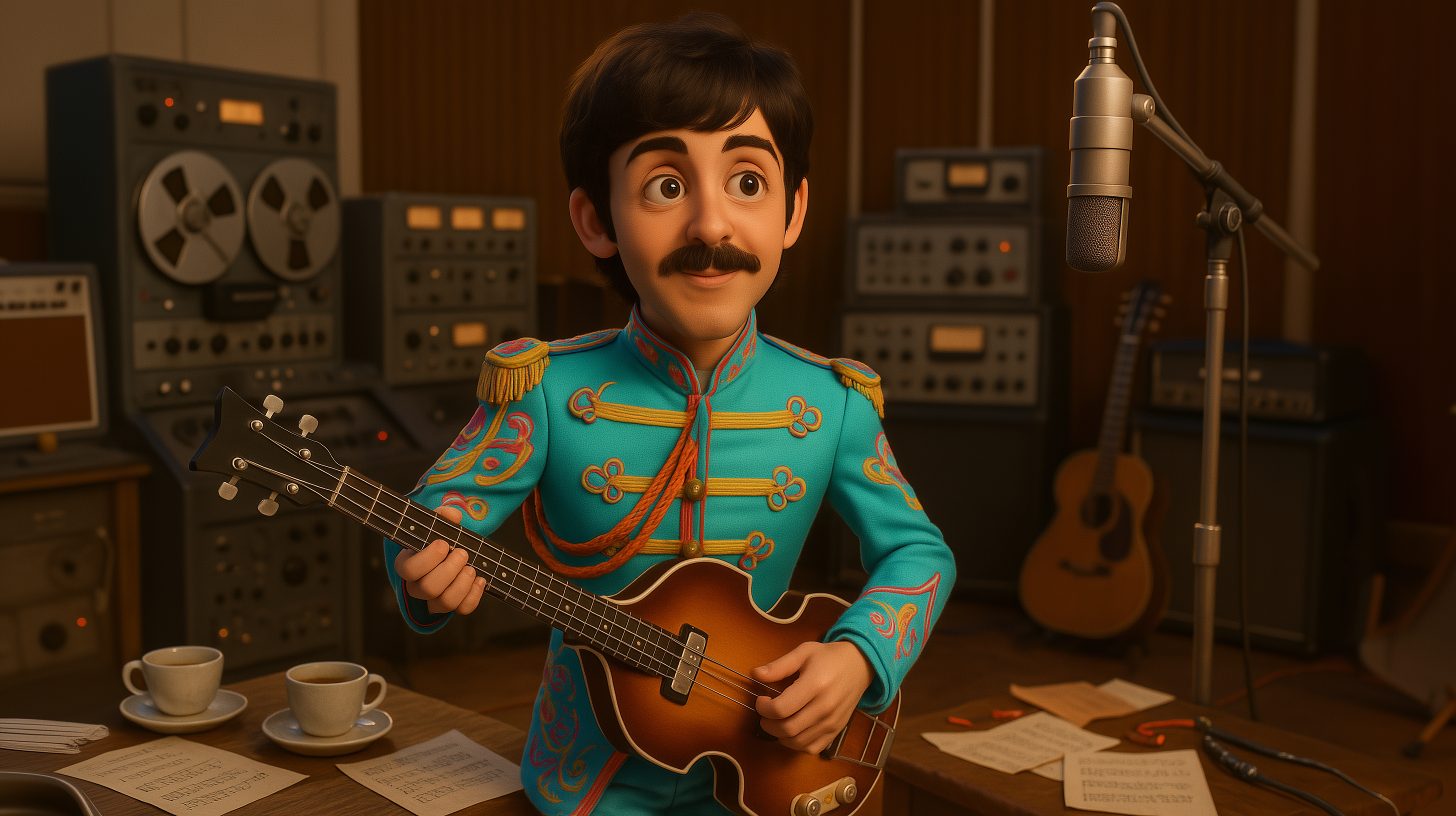
Paul McCartney at the time of “Sgt. Pepper”– Image created with ChatGPT-4o and Midjourney – (CC) Christophe Lachnitt
The editorial role I mentioned earlier was precisely the one Paul McCartney assumed during the creation of Sgt. Pepper, even before he turned 25. He took the artistic lead of the Beatles and steered the album toward a groundbreaking concept: It would be presented as the work of a fictional band, giving them the freedom to experiment thematically, musically, technically – and even visually – outside the bounds of their usual persona.
Sgt. Pepper’s Lonely Hearts Club Band was a true artistic and cultural revolution. The album stood out for its structure: Rather than a collection of songs, it took the form of a concert by this fictional group, allowing for unprecedented thematic cohesion at the time1. Musically, the Beatles explored extraordinary sonic richness through studio experimentation, innovative recording techniques, and a pioneering use of orchestras and diverse instruments. The tracks pushed the boundaries of pop music, blending psychedelic rock, classical music, and Eastern influences. The album was also remarkable for its cover – a collage of cultural and political icons that symbolically tore down the walls between high culture and popular culture.
Sgt. Pepper had global impact far beyond music. It helped redefine the album as a work of art in its own right, no longer just a consumer product. More importantly, it energized counterculture, spiritual exploration, and challenges to societal norms that defined the late 1960s. It became a symbol of its era, influencing not just generations of musicians, but also cinema, fashion, graphic design, and even political thought. Universally recognized as one of the most important albums of all time, Sgt. Pepper entered the global cultural memory, turning so-called “popular” music into a vehicle for societal transformation.
And while generative artificial intelligence may be able to imitate the artistic facets of Sgt. Pepper, it is not capable of conceiving an original work of such magnitude.
The same is true in communications: Artificial intelligence can be a powerful tool in executing a brand or communications strategy, but it is still incapable of originating the kind of founding vision that anchors a brand meaningfully in its time. That role can only be fulfilled by human intelligence – capable of picking up on subtle societal signals, interpreting them, and transforming them into collective momentum. Embedding a brand in its cultural moment is not a matter of data processing, but – as in the case of Sgt. Pepper – a deeply human dual act: Sensing vague aspirations and creating meaning to bring them to life.
This is why communicators, as long as they see themselves in Paul McCartney, remain irreplaceable.
—
1 And presenting the paradox of being too complex at the time to be performed live.
Superception is a media outlet focused on perception issues across communication, management, and marketing in the age of artificial intelligence. It features a blog, a newsletter, and a podcast. It was founded and is published by Christophe Lachnitt.